
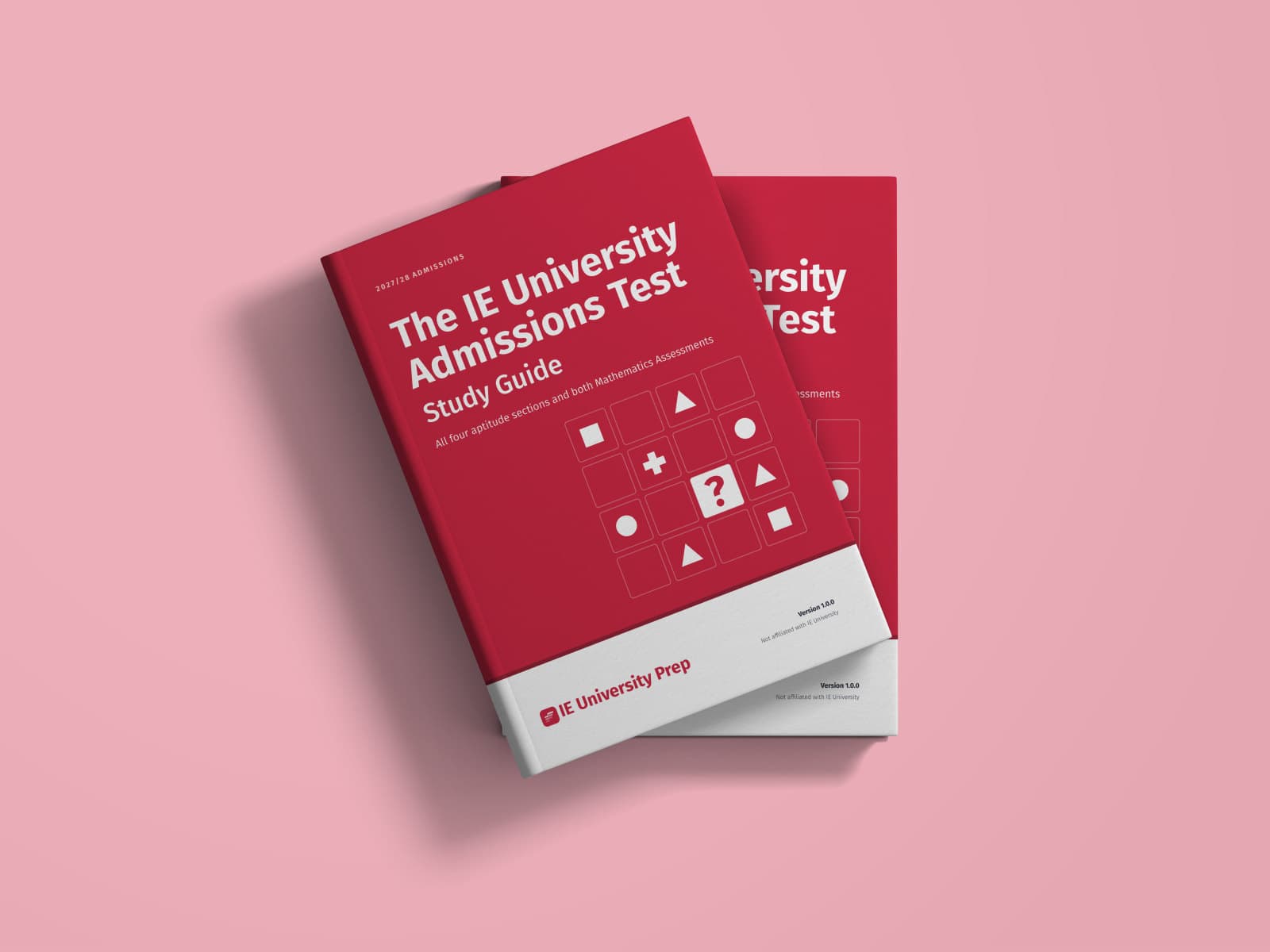
The IE University Admissions Test Study Guide
All four aptitude sections and both Mathematics Assessments, for a test you sit once and whose score you never see, in one free 120-page PDF.
- 37 numerical tasks in 12 minutes and 49 verbal in 12: the three verdicts, a fully worked sheet each, and a pace plan
- Deductive logical thinking: the rule IE's example grids follow, four checks fastest first, and five worked grids
- Both Mathematics Assessments chapter by chapter, each chapter marked for the assessment it belongs to
- A five-block diagnostic with solutions, strategy for a sitting you get once, and formula sheets and a checklist to print
Free. We email you a download link that does not expire.
- Pages
- 120
- Version
- 1.0.0
- Published
- 21 September 2026
- Facts verified
- 17 September 2026
- Cycle
- 2027/28 admissions
- Price
- Free
Real pages from the guide
Four of the 120 pages, exactly as they appear in the PDF.
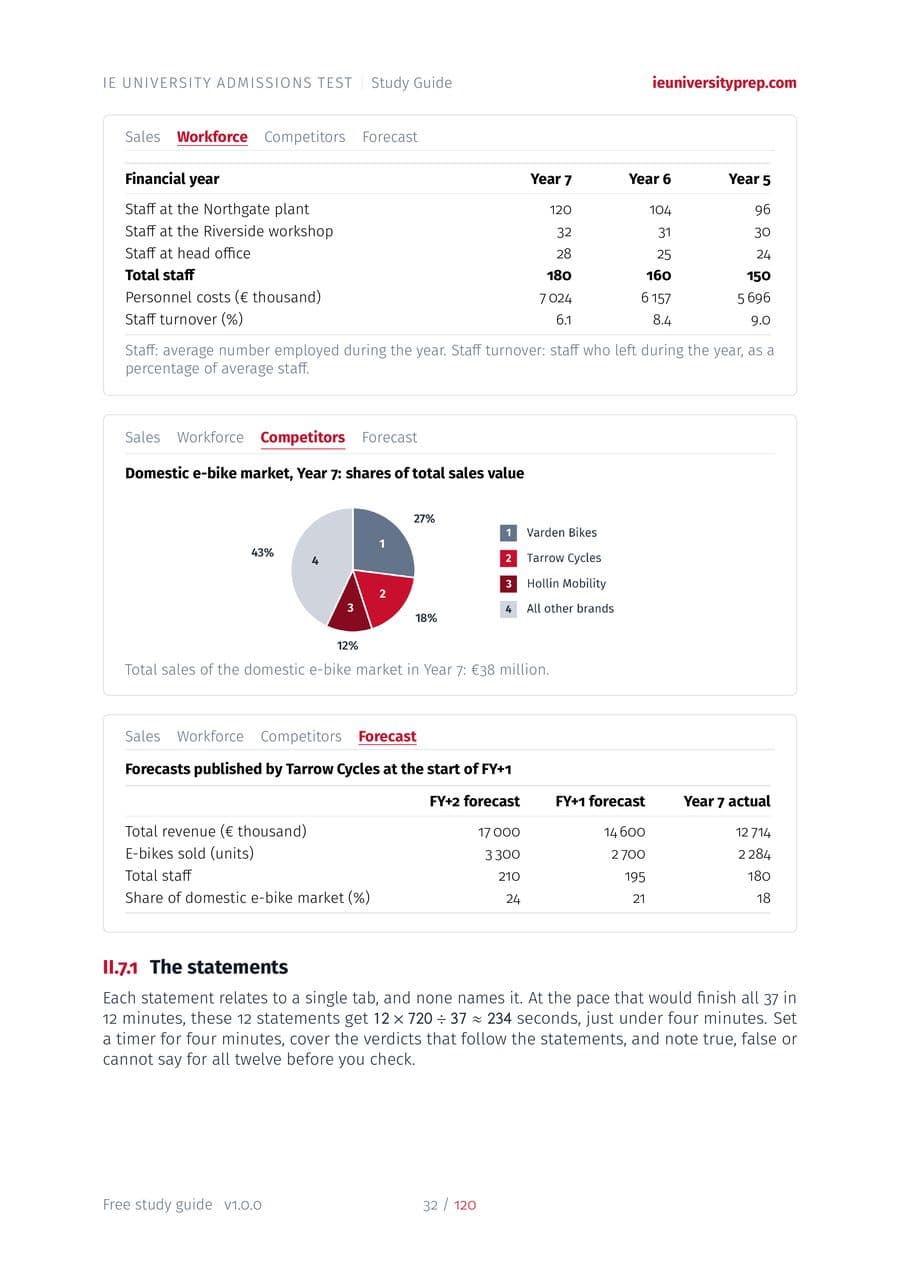
Numerical Reasoning: a worked data sheet, four tabs and twelve statements 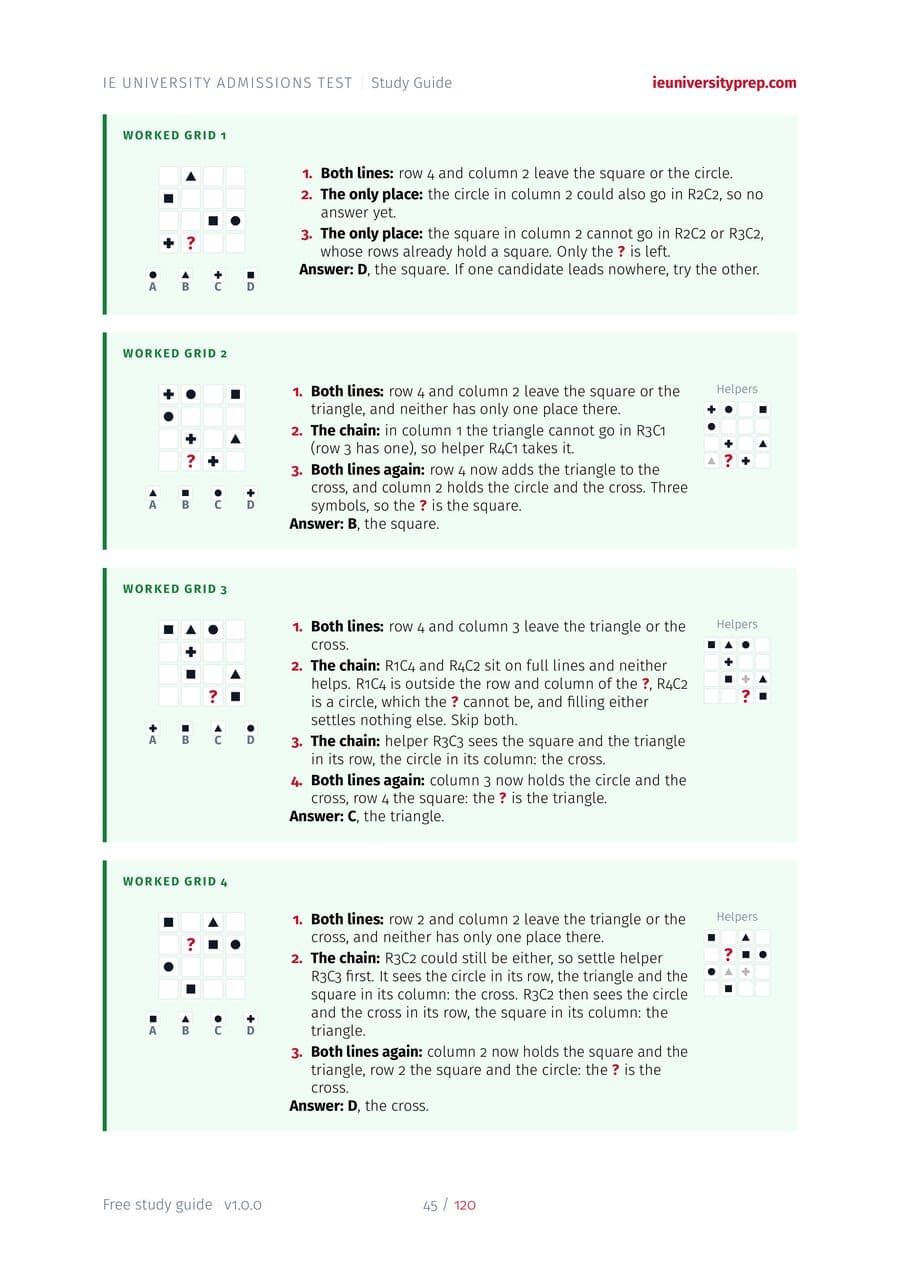
Deductive Logical Thinking: five worked grids, each step named for the check that settles it 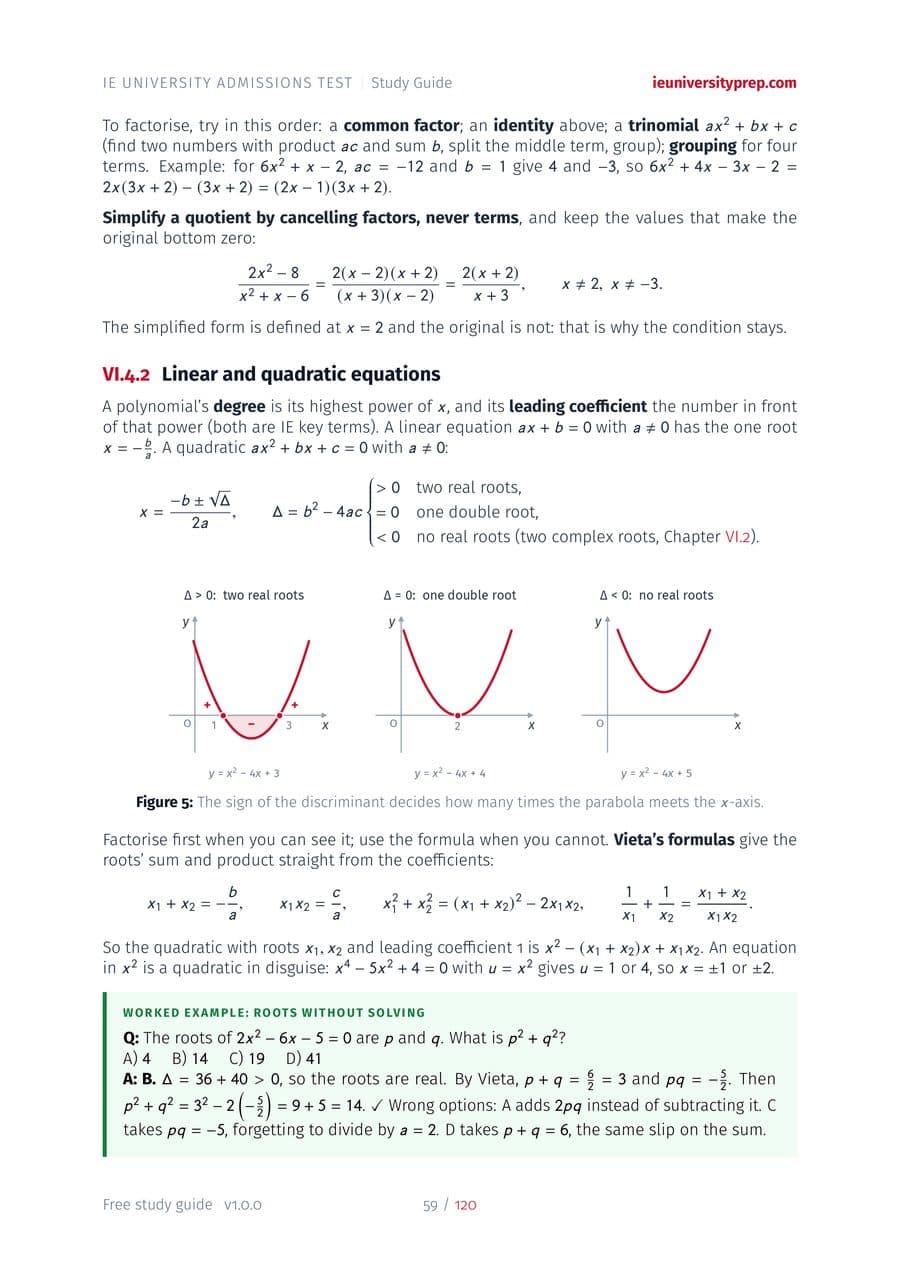
Mathematics: the topics both assessments set, with figures and worked examples 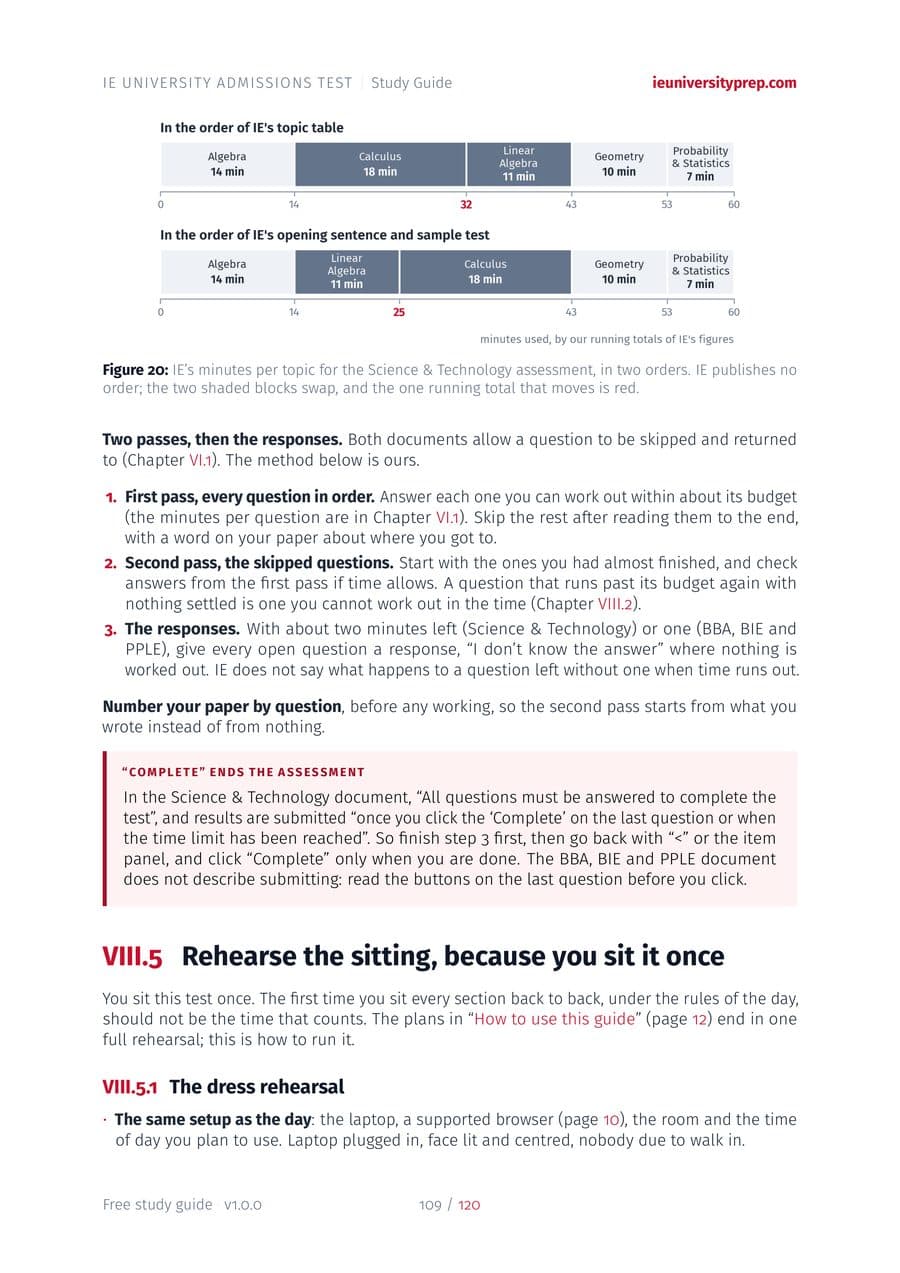
Strategy: pacing the Mathematics Assessment, and rehearsing a sitting you get once
Ten parts, 120 pages, one test
The guide covers the four aptitude sections every candidate sits and both Mathematics Assessments, with every maths chapter marked for the assessment it belongs to, so you take the chapters your programme sets. IE publishes the task descriptions and the minutes for the aptitude sections and a topic list for each maths assessment, and the guide says on every page where its facts come from. Every data sheet, statement, symbol grid, worked example and diagnostic question was written for it: nothing is taken from IE's own sample material or from another publisher.
- Before you start
How the test works
The test in one page; which test you are sitting; one attempt, and how you unlock it and sit it; how it is scored and what IE does not tell you; test day; rounds, costs and the alternatives; how to use the guide with six-week, three-week and ten-day plans and a box for parents; and eleven questions applicants and parents ask.
- Part I
Diagnostic
Five blocks with an answer sheet, solutions and a map back to the chapters: numerical reasoning on an authored data sheet, verbal reasoning on an authored organisation, six deductive grids, and a maths block for each assessment. Learning efficiency gets a note saying why paper cannot test it honestly.
- Part II
Numerical Reasoning
The section in IE's words and the screen its linked example shows, true, false and cannot say on numbers, finding the right sheet fast, the arithmetic in 19 seconds, reading the tables and charts, a fully worked data sheet, and a pace plan for 12 minutes.
- Part III
Verbal Reasoning
What the section is, the three verdicts, the words that decide them, finding the right paragraph, a fully worked sheet, and the traps and the pace for 49 tasks in 12 minutes.
- Part IV
Deductive Logical Thinking
What the section is, the rule IE's example grids follow, four checks fastest first, five worked grids, five-by-five grids, and speed without guessing.
- Part V
Learning Efficiency
What the section asks, the look-alikes where the detail is the memory, a routine for every round, practising without a screen, and what practice cannot change.
- Part VI
Mathematics: algebra and calculus
The two assessments in one page, then numbers, powers, radicals and logarithms, equations and polynomials, intervals, inequalities and absolute values, functions, limits, derivatives and integrals. Every chapter is marked for both assessments or for Science and Technology only, so you take the maths your programme sets and skip the rest.
- Part VII
Mathematics: linear algebra, geometry, probability
The Science and Technology topics: vectors, matrices and systems of linear equations up to three variables; the cross product, lines and planes in space, solids and trigonometry; descriptive statistics, probability and distributions. Each with what you must be able to do, worked examples and the traps.
- Part VIII
Strategy
Scoring you cannot see; the "I don't know the answer" option and the maths decision; pace in the speeded sections and in the maths assessment; rehearsing a sitting you get once; and IE's own free material and how to use it.
- Part IX
Formula sheets and checklist
Two formula sheets (one for both assessments, one for Science and Technology), a one-page reasoning sheet, a printable checklist for the sitting, a maths vocabulary in English and Spanish with a false-friends box, and the sources every fact in the guide comes from.
Verified, and dated
Every fact about the test (the sections and their minutes, both Mathematics Assessments, what IE publishes about scoring, the one attempt, the online sitting) was checked against IE University's official admissions pages, in English and in Spanish, and against its own published PDFs, on 17 September 2026.
Versioned
This is version 1.0.0 (21 September 2026). The version is on the cover and in every footer, so you always know which edition you are holding. Spotted an error? Write to contact@ieuniversityprep.com.
No dates in the PDF
A PDF cannot update itself, so round deadlines and decision dates are deliberately left out. Read them on IE's own admissions rounds page, and the test's rules on its Admissions Test page. IE University Prep is independent and not affiliated with or endorsed by IE University.
Choose your plan
You sit the IE Admissions Test once, and IE never shows you your score. Practice is the only feedback you get.
Single Area
Drill the one area holding you back.
All-Subject Prep
Every area of the test, at the pace it actually demands.
Crash Course + All-Subject Prep
Live teaching on top of everything above.